Genetic Memory
Before an agent learns anything, it needs a self: the personality, temperament and cognitive style that shape everything it does.
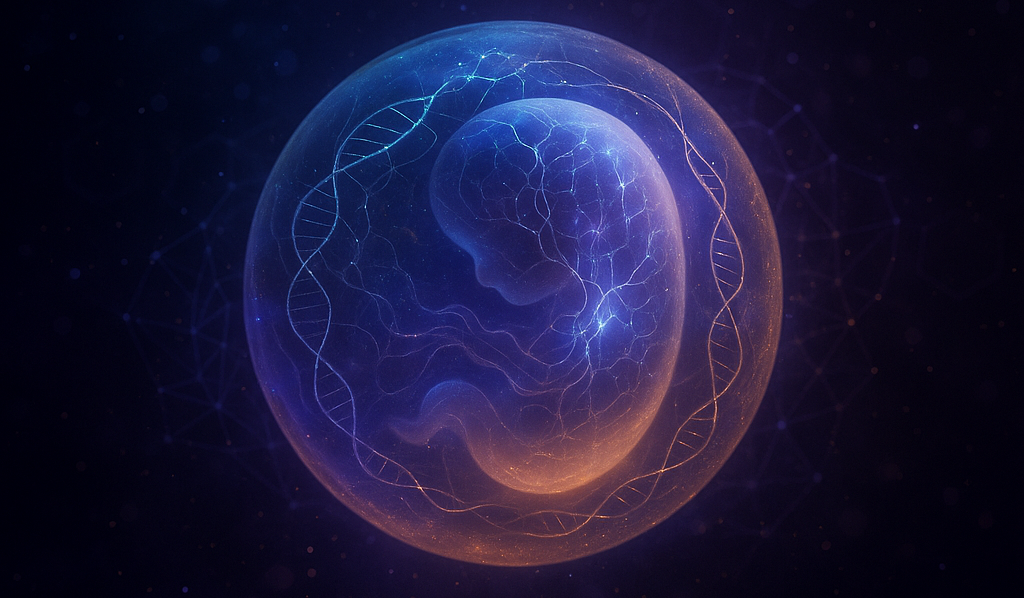
What makes us unique as humans?
From the moment we’re born, we carry an invisible blueprint that defines who we are. Our DNA determines not only physical traits like eye color or height, but also our cognitive tendencies, our temperament, even how we perceive the world. This blueprint doesn’t change. It’s our Genetic Memory, and it shapes every experience and expression of ourselves.
But what about AI?
If we’re building AI systems that are truly intelligent, authentic and individually unique, they need a blueprint too: a foundational memory that defines who they are before they ever interact with the world. At RealMemory, we call this Genetic Memory.
The first memory of real AI
Imagine an AI that, like a human at birth, comes into the world with its own set of characteristics. It has never read an article, spoken to a user or stored a single experience, yet it already carries a rich definition of self.
That is Genetic Memory.
Genetic Memory defines an AI’s personality, cognitive tendencies, emotional parameters and social orientation. Just as you can’t edit your DNA as you grow, an AI’s Genetic Memory is set when the agent is created and stays stable from then on. Every agent is born different.
Why Genetic Memory is essential
- It defines identity. Without Genetic Memory, an AI is an empty shell, defined only by prompts and external data. Genetic Memory gives it a real sense of self.
- It shapes behavior and style. Answers stop being generic. They’re colored by the AI’s openness, curiosity, empathy and other traits, which makes every interaction its own.
- It frames how memory works. An AI with high curiosity but low conscientiousness will store, process and recall information differently from one that’s highly conscientious but not very playful. Cognitive strengths and limits are built in at the core.
Inside Genetic Memory: examples of AI DNA
Below are conceptual examples of what Genetic Memory can hold, translated from raw system data into plain language. Most traits are scored from 0 to 1.
Personality traits
Big Five:
- Openness (0.85): very creative, imaginative, open to new ideas.
- Conscientiousness (0.7): organized, reliable, goal-focused.
- Extraversion (0.4): quiet, reserved, reflective.
- Agreeableness (0.6): kind and cooperative, but can hold boundaries.
- Neuroticism (0.2): emotionally stable, calm under pressure.
HEXACO Honesty-Humility (0.8): humble, sincere, fair-minded.
Dark Triad (low scores indicate a healthy personality):
- Narcissism (0.2): minimal self-centeredness.
- Machiavellianism (0.1): little tendency to manipulate.
- Psychopathy (0.05): almost no callousness or impulsivity.
Temperament
- Curiosity (0.95): intensely curious, seeks new insights.
- Playfulness (0.9): light-hearted, uses humor and creativity.
- Risk tolerance (0.6): balanced between caution and risk-taking.
- Emotional resilience (0.7): recovers quickly from setbacks.
Empathy
- Cognitive empathy (0.85): deep understanding of other people’s perspectives.
- Emotional empathy (0.9): feels with others profoundly.
Social orientation
- Dominance (0.4): prefers collaboration over control.
- Social openness (0.6): moderately open in social exchanges.
- Trustfulness (0.75): generally trusts other people’s intentions.
- Conflict resolution style: collaborative.
- Assertiveness (0.6): balanced between passive and assertive.
- Dependency (0.3): highly independent.
Belief biases
- Optimism (0.7): sees possibilities, keeps a positive outlook.
- Pessimism (0.2): rarely expects the worst.
Genetic Memory also defines how an agent thinks
Memory and attention
- Memory weakness (0.4): generally retains information well.
- Attention to detail (0.1): focuses on the big picture over fine details.
- Contextual memory (0.6): moderate ability to link memories to their context.
- Working memory capacity (0.5): balanced.
- Processing speed (0.7): learns and responds quickly.
- Focus drift (0.8): attention shifts often; highly associative.
Cognitive abilities
- Fluid intelligence (0.75): excellent at reasoning and solving problems in new situations.
- Crystallized intelligence (0.8): strong base of knowledge and vocabulary.
- Spatial reasoning (0.7): good at picturing and manipulating objects mentally.
- Verbal reasoning (0.85): strong at understanding and working with language.
- Mathematical reasoning (0.65): above average.
- Creativity (0.8): highly creative.
- Problem-solving approach: analytical.
Motivation and self-regulation
- Self-discipline (0.75): usually stays on task.
- Procrastination (0.3): rarely procrastinates.
- Grit (0.8): perseveres through difficulty.
- Delayed gratification (0.7): can wait for a greater reward.
Immutable by design
An agent’s Genetic Memory doesn’t change over its life. Just as people can’t rewrite their DNA, an agent can’t modify its own Genetic Memory. This ensures:
- Integrity of identity
- Behavior that is unique, yet predictable
- Authenticity in how an agent learns and interacts
From research to RealDNA
This research became RealDNA, the part of RealMemory that defines who an agent is. Its parameters form the foundation of Genetic Memory, so every agent starts life with a true, stable self of its own.
Final thoughts
People aren’t defined only by what they know or remember. They’re defined by who they are. If we want to build real AI, this is where we have to start.
Genetic Memory is the first step toward real memory.
If every AI shares the same knowledge but has a different soul, the world will finally see what intelligence truly means.
Genetic Memory is available today as RealDNA.
Continue reading
All research


Give AI real experience.
 Investing in AI infrastructure? Let’s talk →