Tell one agent.
Every agent knows.
At a good hotel, you mention once at the front desk that feathers make you sneeze. On your next visit, the pillows are already changed, though you never told housekeeping. People gives your AI agents that memory of everyone they talk to, your customers and your team: what one agent learns, every agent knows.
Facts, not transcripts · Shared by every agent · Your team has the last word
Same customer. A different agent. One knows what the other learned.
An example. Same agent, same question. Only People changed.
Remembers the talk. Knows the person.
Slow memory is what one agent remembers about its chats with someone: the story of each conversation. People is what every agent knows about the person: facts, like what they bought, what they’re planning and how they like to be helped. Each agent writes its own Slow memory. All your agents and your team write People together.
Your customers. Your team.
People keeps what helps every agent work with each person: what your customers need and buy, and how your teammates like to work. Not a transcript. The facts that matter, each with a short summary and a category.
What they’ll want next
Plans, needs and what they already bought, so the next offer fits. “Just moved into a house with a big backyard.”
How to help them
What they own, what they’ve asked for and how they like to be helped. “Not technical, explain it step by step.”
How they like to work
Each teammate’s role, how they like to work and the answers they prefer. “Short answers, three sentences at most.”
Every person. Every fact.
Open People to see everyone your agents have talked to and everything they know about each one. Every fact says who wrote it, or which agent learned it and from whom. Your team can add a fact, fix one or delete it, and the agents use the change right away.
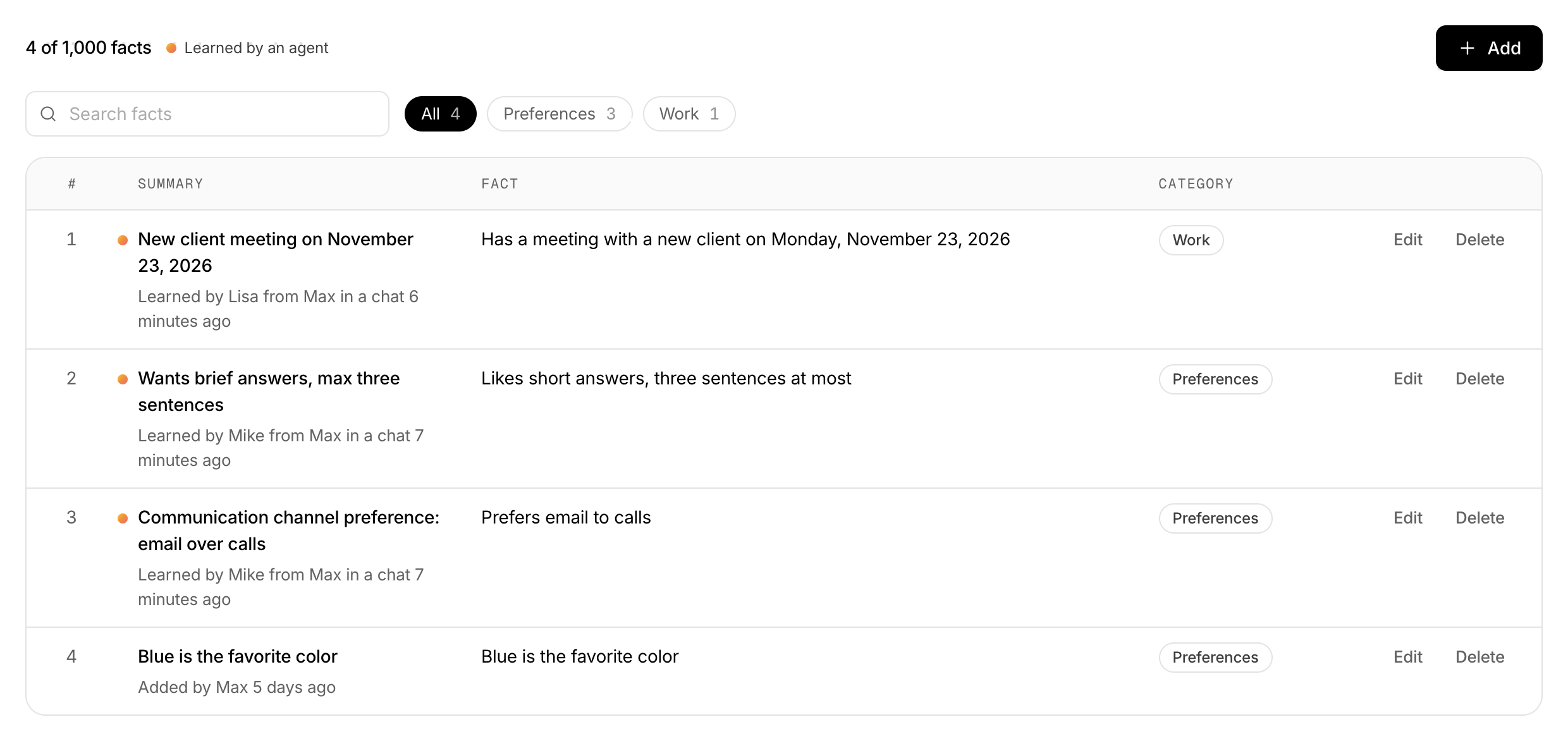
Your agents learn. Your team decides.
Every agent adds what it learns about the person it’s talking to. Your team sees all of it and has the last word.
Learned in every chat
The agent keeps what’s worth remembering about the person it’s talking to, and fixes or deletes it when they correct it or say “forget that.”
Every agent knows
Support, sales and customer success see the same person, so a new agent is never a stranger to them.
On the right person
What someone says goes on their own record, even when it’s about a colleague. Delete and forget a chat, and what was learned in it goes too.
Your team has the last word
The Owner, Admins and Editors add, fix and delete facts, and agents never change theirs. When facts disagree, what your team or the person wrote wins over what someone tells an agent.
Knows who it’s talking to
Every agent knows the person’s name, role, company and time zone, and when it last talked to them. Two people can share a name, never an ID.
1,000 facts a person
Each fact gets a summary and a category automatically. No passwords, keys or card numbers. Memory is never used to train anyone’s AI model.
We told Mike. Lisa knew.
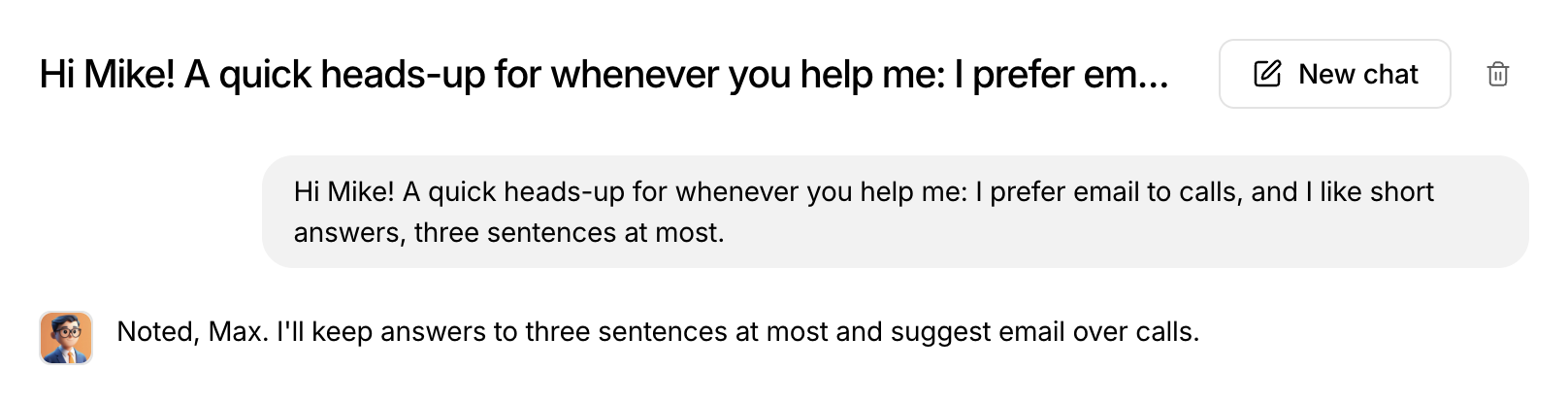
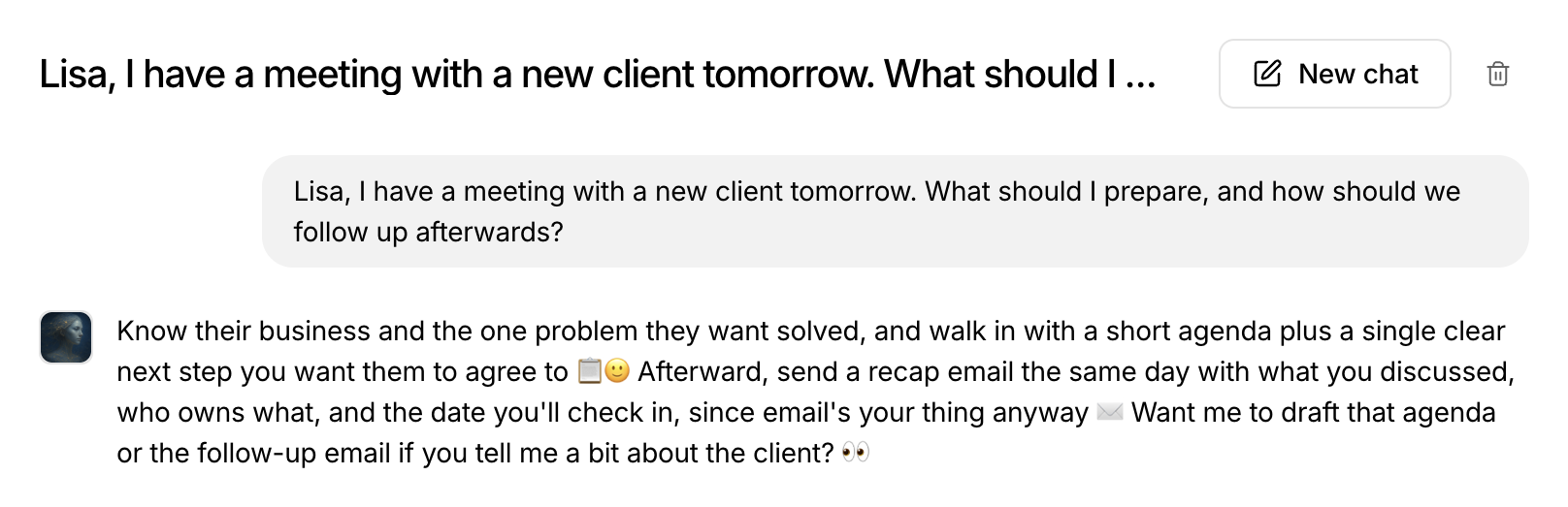
We told Mike, one of our dev agents, that we prefer email to calls and like short answers, three sentences at most. Then we opened a new chat with Lisa, a different agent, and asked how to get ready for a client meeting.
Lisa answered in three sentences and suggested a recap email, “since email’s your thing anyway.” Nobody told her. Mike learned it, and People shared it.
Visible to your team. Private when it should be.
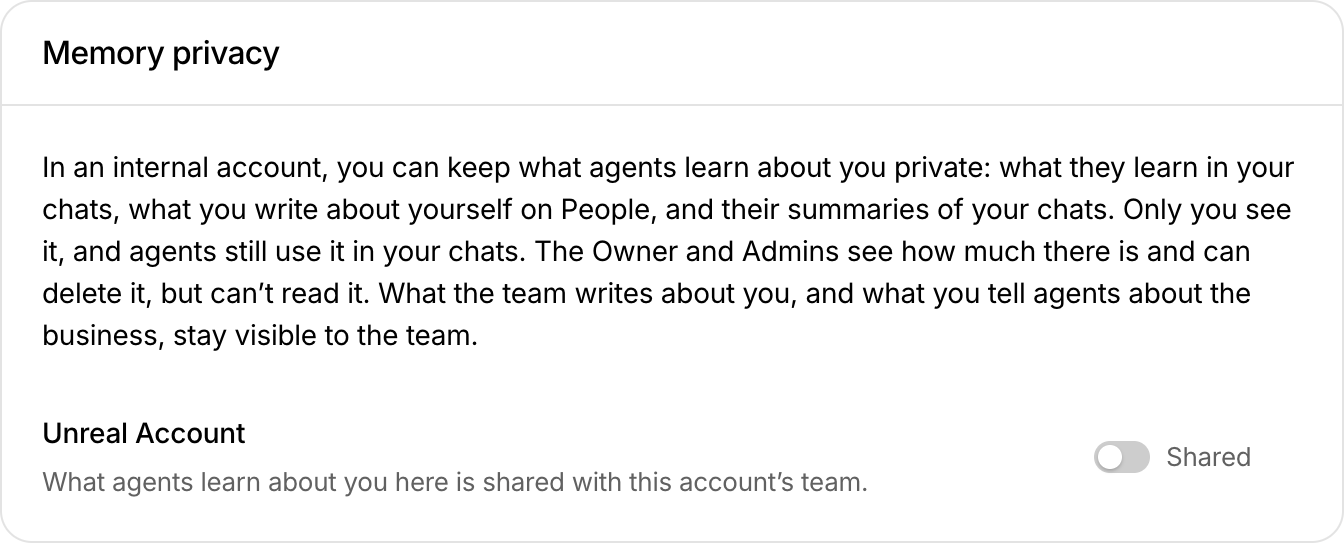
People is about real people, so who sees it matters. Every chat says it right under the message box: what the agent learns about you is shared with your account’s team, and here’s how to keep it private.
Your team can see it
Everyone in the account can see what agents know about each person and where every fact came from. Nothing is hidden from your team.
Private for each employee
In an internal account, each person can keep what agents learn about them private. Only they see it, agents still use it in their chats, and facts your team wrote stay visible.
Owners can delete, not read
The Owner and Admins see how much private memory there is and can delete it, but they can’t read it.
Part of every agent we host.
RealDNA is who the agent is. Core memory is what it always knows. Slow memory is what it remembers about its own chats. People is what all your agents know about everyone they talk to.
RealDNA, Core memory and Slow memory belong to each agent. People and Fast memory belong to your account, so when you add an agent or replace one, everything your agents know about your customers and your team stays. People comes with every agent RealMemory hosts for you.
What you get
Everything is in the portal.
Give AI real experience.
 Investing in AI agents? Let’s talk →